This page is an editorial and informational resource about the cold chain for
freeze-dried materials — what the drying process removes, how a temperature record is built and
read, how a temperature-controlled shipment is packed and qualified, and what an unbroken chain
of custody looks like on paper. It is written for professional and trade readers who evaluate
supplier logistics as part of their work.
SynthroLabs sells nothing. It is a published editorial resource, not a shop, not
a laboratory and not a carrier. Nothing here is an offer, and no order can be placed through this
site. The practices described are general explanations of common industry procedure — not a
substitute for the written handling instructions that come with a specific consignment.
Nothing on this page is guidance on the selection, preparation or end use of any material, and
no claim of any kind is made or implied about what any material does. This resource is written
for readers aged 21 and over.
In this guide
What you will find on this page
What drying removes
Sublimation, primary and secondary drying, and why residual moisture is the number that matters.
The temperature record
Loggers, sampling intervals, excursions and mean kinetic temperature — a record, not a moment.
Packing and transit
Insulation, coolant choice, payload-to-void ratio, and what packaging qualification actually proves.
Receiving and storage
Eight failures worth catching on arrival, and the storage habits that keep a record intact.
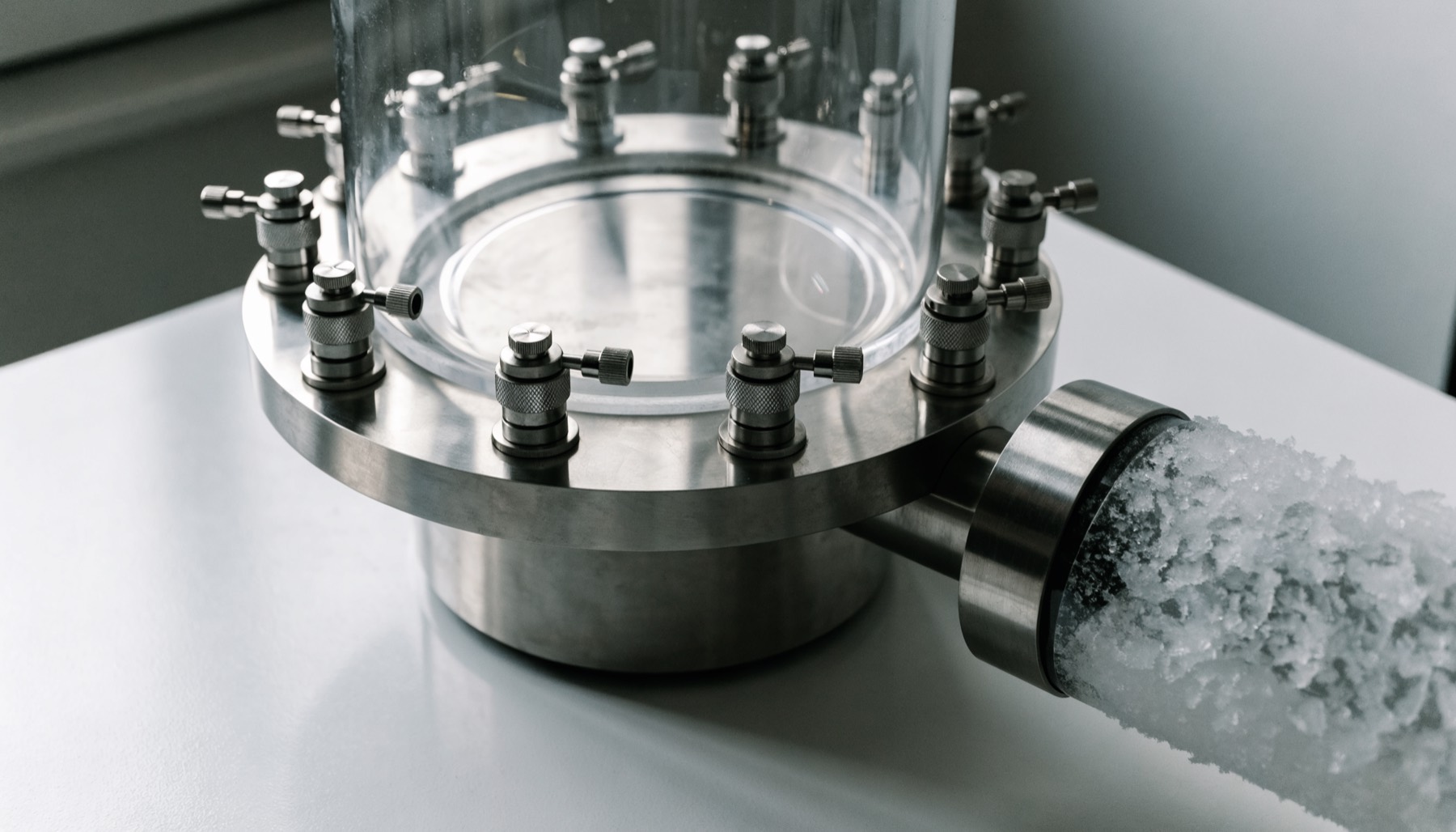
Freeze-drying does not heat water away — it removes it as vapour from the solid state, which is why the process runs under vacuum with a cold trap.
Handling guideSynthroLabs editorial2 September 202611 min read
The cold chain for freeze-dried materials — and how to tell whether yours held
Almost every supplier of temperature-sensitive material will tell you the shipment travelled
cold. Far fewer can show you the record that proves it, and fewer still can show a record that
covers the whole journey rather than the part of it that went well. That record is the entire
point of a cold chain, and reading one takes about ten minutes to learn — after which a working
record is easy to tell apart from a decorative one.
This guide covers what freeze-drying actually does to a material, why the appearance of the dried
cake is a quality signal rather than a cosmetic detail, how a temperature record is built and what
the numbers on it mean, how a cold shipment is packed and what "qualified packaging" is a claim
about, what to inspect before a delivery goes into storage, and the storage habits that quietly
determine whether the record stays unbroken after it arrives.
What freeze-drying actually removes
Lyophilisation — freeze-drying — is a drying method that avoids the liquid phase entirely. The
material is frozen solid, the pressure around it is dropped below the triple point of water, and
the ice is then persuaded to pass straight from solid to vapour without melting first. That
transition is sublimation, and it is the whole mechanism.
The reason to go to that trouble is that water is what makes most degradation possible. Remove it,
and the chemistry that needs a solvent slows to a crawl. Removing it by evaporation would mean
heating the material and passing it through a liquid state on the way out, which is precisely what
a heat-sensitive material cannot tolerate. Sublimation gets to the same place without the heat and
without the meniscus.
The cycle has three stages, and they are not interchangeable. Freezing sets the
ice crystal structure, which in turn sets the pore structure the vapour will later escape through
— freeze too fast and the pores are small and the drying is slow; freeze too slow and the structure
can be coarse and uneven. Primary drying removes the frozen water by sublimation
and takes most of the cycle time. Secondary drying then raises the shelf
temperature to pull off the water that is bound to the material itself and never froze at all.
That last stage is the one people forget, and it is where the number that matters comes from.
A cycle can look complete — the ice is gone, the chamber pressure has settled — while several
percent residual moisture is still bound in the cake. Residual moisture is the single most
useful figure on a freeze-dried material's paperwork, because it is the one that predicts
how the material will behave over the following months rather than on the day it was made.
The cake is evidence, not decoration
The closure is part of the barrier. A stopper that has lifted, or a crimp that turns, makes everything upstream of it irrelevant.
A properly dried cake is a solid, uniform plug that fills roughly the volume the liquid occupied
before drying, with a matte, slightly porous surface. It holds that shape because the structure
set during freezing survived the drying. When something in the cycle went wrong, the cake usually
shows it, and the vocabulary for what you are looking at is worth knowing.
Collapse — the cake has slumped into a dense, glassy or syrupy layer instead of
holding its porous structure. It means the product temperature rose above its collapse temperature
during primary drying. Collapsed cakes typically retain more moisture and dissolve less predictably.
Meltback — a wet or discoloured region, usually at the base, where ice melted
rather than sublimed. Localised, but the paperwork covers the whole vial.
Shrinkage or pull-away — the cake has contracted from the wall of the container.
Usually cosmetic, sometimes an early sign of the same thermal problem as collapse.
Powdering or fines — the structure has broken up in transit. Not necessarily a
drying fault, but it tells you something about how the shipment was handled.
None of this requires equipment to spot. It requires looking at the container in decent light before
it disappears into a freezer, which is the step most often skipped because the delivery arrived at
an inconvenient moment.
Temperature is a record, not a moment
The most common misunderstanding about cold chain is that it is a state — the box was cold, or it
was not. It is not a state. It is a continuous record over time, and the useful
question is never "was it cold on arrival?" but "what does the record show for the entire interval
between dispatch and receipt, and who holds it?"
That record comes from a data logger travelling with the consignment. A logger is a small device
that samples temperature at a fixed interval and stores each reading with a timestamp. Three of its
settings determine whether the record is worth anything:
Setting
The question it answers
What goes wrong
Sampling interval
How often is a reading taken?
A one-hour interval can miss a forty-minute excursion entirely
Start delay
When did recording actually begin?
A delay set too long leaves the first hours of the journey unrecorded
Placement
What is the sensor actually measuring?
A logger taped to the outer carton measures the warehouse, not the payload
Calibration
Are the readings traceable?
An uncalibrated logger produces a chart, not a measurement
Alarm limits
What counts as an excursion here?
Limits set wider than the material's specification will never alarm
A single-use logger with a pass/fail indicator is a summary of these settings, not a replacement for
them. If the indicator says "pass", it is worth knowing what it was set to consider a failure.
Excursions, and the arithmetic behind them
An excursion is any period during which the recorded temperature sat outside the
specified range. Two things about it are routinely misread. First, an excursion is defined by
duration as well as magnitude: two minutes at the edge of the range and nine hours at the
edge of the range are not the same event, and a record that reports only the maximum reading has
thrown away half the information.
Second, mean kinetic temperature is not an average. It is a weighted calculation
that reflects the fact that the effect of temperature on chemical degradation is not linear — time
spent warm counts for disproportionately more than time spent cold. Averaging a journey that spent
one hour badly warm and twenty hours correctly cold produces a comfortable number that describes
nothing that happened. Mean kinetic temperature exists precisely because the comfortable number is
misleading.
The practical consequence: a record showing a brief excursion, reported openly with its duration and
an assessment against the material's stability data, is more trustworthy than a record showing a
perfectly flat line. Flat lines happen. They also happen when the logger was started late, placed
outside the payload, or read after the fact from a device that was never calibrated.
Packing a shipment that survives its own journey
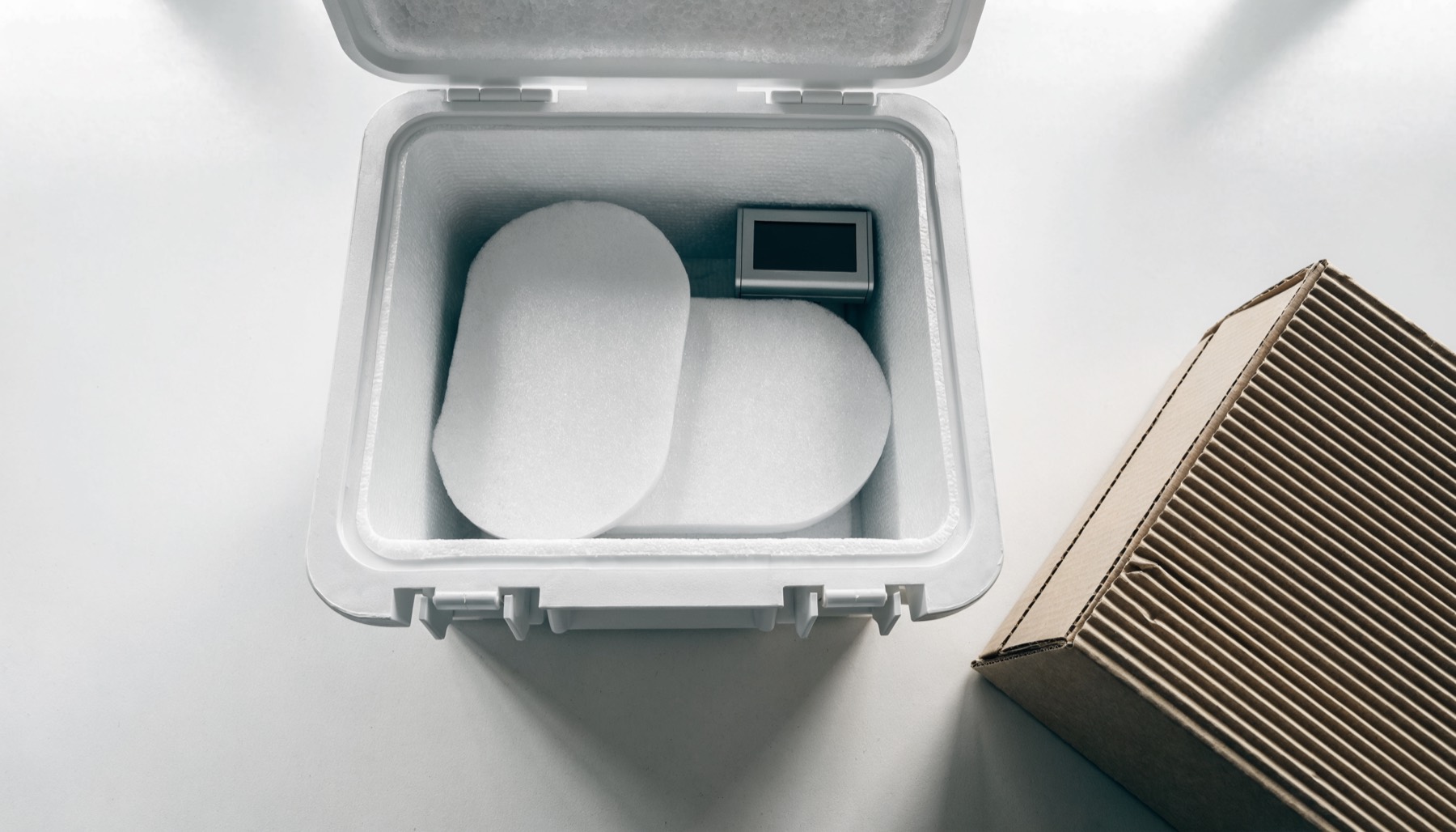
The empty space in a cold box is not spare room — it is the part of the payload the coolant has to keep cold for nothing.
A temperature-controlled shipper is a system, not a box. It has four parts that have to be designed
together: the insulation, the coolant, the payload space, and the transit time it was built for.
Change any one of them and the others stop being right.
Insulation slows heat transfer; it does not stop it. Expanded polystyrene is
cheap and adequate for short journeys; vacuum-insulated panels hold a temperature far longer and
cost accordingly. Neither creates cold — they only buy time.
Coolant determines the temperature the box holds, not just how long it holds
one. Water-based gel packs hold near 0 °C as they melt. Phase-change materials are formulated to
hold a specific plateau, which is why a shipment meant for 2–8 °C is not simply a frozen shipment
with less ice. Dry ice sublimes at around −78 °C and brings its own handling and transport rules.
Payload-to-void ratio is the quiet one. A half-empty box has a large air volume
that the coolant must cool and then keep cool, which shortens the hold time and lets the payload
move. Void fill is not padding; it is part of the thermal design.
Transit time is the specification the whole system is built against. A shipper
qualified for 48 hours is a statement about 48 hours. At hour 60 it is an ordinary box.
What "qualified packaging" is actually claiming
Packaging qualification means the configuration was tested in a chamber against a defined temperature
profile — a summer profile and a winter profile, typically — with a defined payload, and held the
required range for a stated duration. That is a genuinely meaningful claim, and it is also a narrow
one. It applies to that configuration: that box, that coolant quantity, that conditioning
procedure, that payload mass, that duration.
The failure mode is substitution. Half the coolant because the box felt heavy, a different void fill
because the usual one ran out, packs taken straight from a freezer when the procedure said condition
them for two hours first — each of these is a small, reasonable-sounding decision that puts the
shipment outside the configuration the qualification covers. The qualification report is still true.
It just no longer describes what was shipped.
Arrival: the ten minutes that decide everything
A cold chain is a chain of custody, and the receiving step is where most of them quietly break —
not because anything dramatic happens, but because a box arrives during a busy hour and goes into a
freezer before anyone looks at it. Once that has happened, nothing about the journey can be
reconstructed.
A receiving procedure that works fits on one card. Record the time of arrival before anything else,
because every later reading is meaningless without it. Read and download the logger before opening
the payload. Inspect the outer carton for crush damage and water staining, then the inner shipper,
then the containers themselves. Check the coolant: gel packs entirely liquid and at room temperature
say something about the journey that the logger's summary indicator may not. Confirm the batch
identifiers on the containers match the ones on the delivery paperwork. Only then does anything go
into storage.
If something is wrong, the useful action is to photograph it and quarantine the consignment rather
than to put it away and raise it later. A quarantined shipment can still be released. A shipment
already in the freezer among everything else cannot be un-mixed.
Storage: the boring parts that actually matter
Storage failures are less dramatic than transport failures and considerably more common, because
they accumulate. A freezer that is nominally correct can still be the reason a material does not
behave the way its paperwork suggests.
Set point is not actual temperature. The set point is what the controller is
aiming at. What matters is the measured temperature at the shelf where the material actually sits,
which in a domestic-style unit can differ from the set point by several degrees.
Door openings are the main disturbance. In a busy unit, the temperature near the
door swings on a cycle that the controller's own display never shows, because the controller's sensor
is not near the door.
Freeze-thaw cycling is cumulative. Ten small excursions are not equivalent to
one long cold period; each transition is its own stress. Frost-free units are actively unsuitable for
exactly this reason: the defrost cycle is a deliberate, repeated warming.
Moisture is the enemy of a dried material. Ambient humidity entering a container
undoes the work the drying cycle did. Desiccant, an intact closure and a minimum of transfers between
containers all address the same risk.
Light and mechanical stress matter for some materials and not for others, which
is why the supplier's written storage conditions beat any general rule, including this list.
Rotate by earliest expiry, not by convenience. Stock that migrates to the back of
a shelf ages there.
The habit worth building is monitoring the storage unit itself, continuously, with its own logger and
its own alarm — independent of the appliance's built-in display. A unit that fails over a weekend is
an entirely different event depending on whether anyone finds out on Saturday or on Monday.
Eight things that should stop you
No logger in the shipment. Without a record there is no cold chain — only a
claim about one.
A logger outside the payload. Taped to the outer carton, it measured the van.
A record that starts after dispatch. The unrecorded hours are exactly the ones
worth seeing.
A summary indicator with no underlying data. A green light is a judgement someone
configured, not a measurement you can check.
Coolant fully melted and at ambient. The box ran out of hold time before it
arrived, whatever the indicator says.
Substituted packaging components. Different coolant, less of it, or no void fill
puts the shipment outside the qualified configuration.
Batch identifiers that do not match the paperwork. Everything upstream becomes
unverifiable at that point.
A visibly collapsed or melted-back cake. Whatever the temperature record says
happened, the container is telling you something different.
None of these require instruments to catch. They are all visible in the first ten minutes after a
delivery arrives, which is what makes them worth building a habit around.
A ten-point receiving checklist
Record the arrival time before opening anything.
Locate and read the data logger, and download the full record rather than the summary.
Check when recording started and at what interval it sampled.
Note every excursion with both its magnitude and its duration.
Inspect the outer carton and inner shipper for crush damage and water staining.
Assess the coolant — quantity, state, and whether it matches the packing procedure.
Inspect the containers themselves: closures seated, crimps intact, cakes uniform.
Match batch identifiers on the containers against the delivery paperwork.
Move to the specified storage condition without an intermediate stop on a bench.
File the record — logger data, photographs, receiving notes — against the batch, not the date.
Ten steps, most of them a few seconds each. The pattern behind them is consistent: suppliers who can
produce a complete record tend to have the systems that produce complete records, and suppliers who
produce a reassuring summary tend to have the summary.
More about SynthroLabs
Who publishes this resource, why it exists, and how to reach the editor with a correction or a question about the guide.
SynthroLabs is an editorial resource on the cold chain for freeze-dried materials, published by
Synthro Lab LLC. It exists because the questions worth asking about a temperature-controlled
shipment are almost always the same ones — what was recorded, from when, by which device, and
against which limits — and they are easier to answer once, properly and in public, than one
conversation at a time.